
Flyball Basics

Flyball may be a great option in dog sports for you and your canine companion if you have a breed that requires more exercise than a daily walk. Some breeds just have a bit, or lots, more energy to burn off and flyball training may be a good way to expend it. In short, flyball is a fetch, hurdle-jumping relay race against another team of dogs. Let me explain…

What is Flyball?

There are two teams of four dogs that race against each other, side by side, on a 51 foot course. On the course, there are four hurdles the dogs must jump over spaced ten feet apart. Each dog, one at a time, runs down the course jumping each hurdle, in turn. Then retrieves a ball before racing back to the beginning of the course, jumping the hurdles along the way, with the ball in their mouth.

Each dog is set loose down the course, one at a time, as the dog before him crosses the finish line. Down the course, over each hurdle, to a spring-loaded box that ejects a tennis ball when the dog steps on it. The dog retrieves the ball and hurdles his way back down the course to the finish line to send off the next dog. The team whose final dog crosses the finish line first wins.
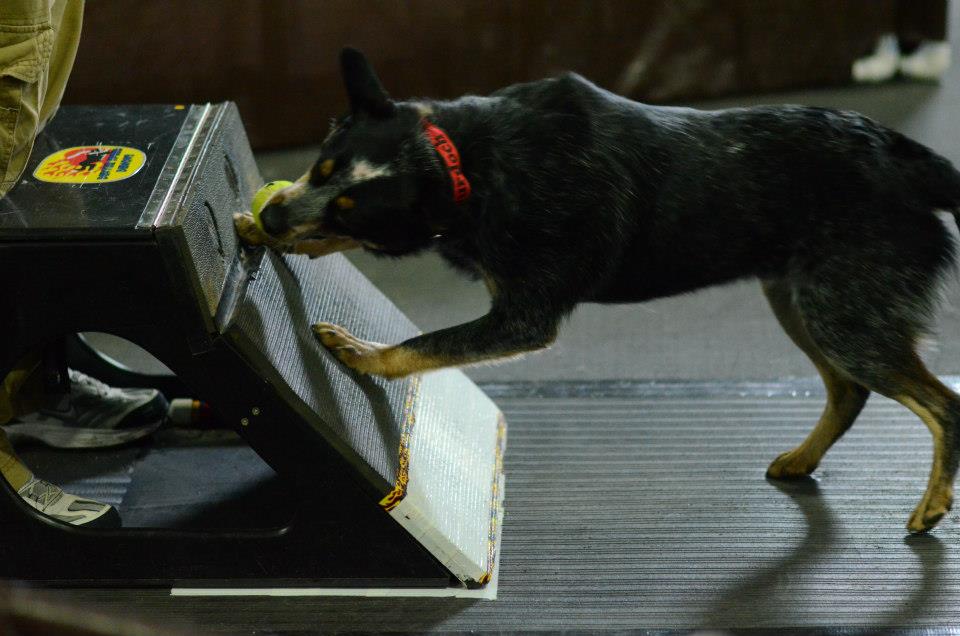
Australian Cattle Dog releasing tennis ball

Who Can Compete?

Any size and breed of dog can compete in flyball. The hurdles on the course are determined by the smallest dog’s height on the team. This is known as the “height dog”. The height of the hurdles is based on their height at the shoulders. While any breed can compete in flyball, breeds known for retrieving and herding typically do the best.

How Can I Train My Dog for Flyball?

  • Start with the basics. Teach your dog to fetch and not release the ball until commanded.
  • Move on to teaching your dog to jump one hurdle by getting him to fetch a ball on the other side of the hurdle.
  • Once your dog can jump one hurdle, add a second hurdle placed ten feet apart. Continue adding hurdles up to four.
  • Finally, teach your dog to jump on the spring loaded pad that will release the tennis ball.
  • Now you’ve taught your dog all the parts of the course. Put them all together in order and team up with three other dogs to race!

Flyball isn’t learned overnight. You will need to work with your dog in small increments of 10-15 minutes at a time. Practice two-to-three times a day, consistently, until your dog gets each skill down. Remember to continue practicing the other skills you have already learned while learning new skills. You will be “flying” down the course in no time.

Tips to Getting Started with Dog Agility Training

So, you’re thinking about getting started with dog agility training. Maybe you saw a competition on TV and thought it looked like a fun way to spend time with your dog. Agility training, by nature, definitely strengthens your bond with your dog. It is a team sport between the two of you and requires a lot of communication, strategy, and teamwork. However, before you begin teaching your dog the obstacle course part of agility training, there is some more basic training to consider.

Getting Started with Obedience Training

Prior to starting with agility training, basic obedience training is a must. Your dog should be able to follow basic commands like sit, stay, down, come and walk before moving on to something more sophisticated like dog agility. Also, equally important is your relationship with your dog. In agility, you are a team and it should be fun. Praise your pooch for getting it right and take care of their emotional needs. They will go further faster.

Agility is just for fun, so be sure to make it fun. Keep your expectations and session durations short to begin with. You don’t want training to outlast your dog’s attention span. When your dog is performing well and enjoying himself, he’ll be successful and the training will go better. As he improves raise your expectations in increments slowly. Be careful not to push too hard. Keep it fun and you’ll get better results.

Getting Started with a Strong Bond

This is a team sport between you and your dog. As the handler, your dog must focus on you and you alone. Start out practicing in a quiet place without any distractions. The goal here is to train your dog to make eye contact with you on cue without using a verbal command. This will be necessary as the dog runs the agility course and for him to know where to go. Especially as he gets farther away from you at times.

Getting Started with Dog Agility Training Obstacles

The obstacles on the agility course are pretty standard and include an A-frame, dog walk, see-saw and other featured elements like a tunnel, weave poles and pause box. However, they will not always be in the same order. Your dog will need to know which obstacle to go to next without following you. You may not be in the lead at all times on the course.

So, spending a little extra time with your dog overall is considered getting started with dog agility training. Take some extra time to strengthen those non-verbal communications between the two of you. Start working on getting them to touch their nose to your hand or to a target. Practice hand signals. Keep their attention on you with treats and other rewards.

Join PlexiDor Dog Doors again next week for more information on training for the different obstacles in the dog agility course. Our standard and electronic dog doors come in sizes small through extra-large to fit Chihuahuas up to Great Danes. Our doors can be installed in walls, doors, sliding glass, French doors, glass house doors and windows. Contact our Customer Service Department today with any questions or call 888-PETDOOR.